What to see and do before and after the charter.
We hope you will too. The sailing is FANTASTIC (that goes without saying), and we'll have a lot more to come about the route and our likely destinations along the coast. Trust us — you're going to love it.
But there is a great deal more to see and do before and after the charter. That's what this article is about.
The short version: Split before the sail, then Korčula and Dubrovnik after — all three are strung along the same ferry line, and each is worth a day or two on its own. Add a few days on either end and a week on the water becomes a proper Croatian trip.
Split is a fascinating place, well worth a day or two before or after sailing. Last time, we all met in Split the evening before heading to the boat and had a great group dinner there. We think we should do that again.
The area around Split was the boyhood home of the Roman Emperor Diocletian, who was born nearby and returned — after a pretty successful career — as the first Roman emperor to take a "retirement." He liked the area enough to build his retirement palace, around 300 CE, in the center of what has become modern Split. Much of the palace complex is still there: the substructure, many of the walls, and most of his mausoleum. And it can be visited — hard to avoid, actually. It's literally all around you as you walk through the city.
Diocletian was not especially popular with later Christians (he did launch the first official Roman persecution of Christians, after all), so his body was eventually tossed out and his mausoleum converted into a Christian cathedral. It's often called the oldest cathedral building still in use anywhere in the world, and it remains a working Catholic cathedral to this day. Well worth the price of admission. There's also an iconic medieval bell tower right in front of it, with fantastic views over the city.
The rest of Split is a warren of narrow medieval streets with quaint plazas, terrace restaurants, fascinating architecture, open-air markets — and roughly one gelato shop per block. (Gelato is a BIG deal in Croatia.) Just outside the city there's a large Roman aqueduct that is still a major source of the city's drinking water. The waterfront, steps from the historic center, is a long promenade lined with cafés and restaurants, with a cruise-ship terminal on one end and busy ferry traffic to all the popular islands along the coast.
We liked Split A LOT. There are small, fairly affordable boutique hotels right in the historic center, and you won't need a car — the entire old town is closed to vehicles and everything is walkable. So give Split a try!
After the Sail
The next spot Donna and I are headed is Korčula — and you're welcome to join us if you'd like. It's a stunning island and town about two hours southeast of Split by ferry. (It's the same ferry that continues on to Dubrovnik, about two hours beyond Korčula.)
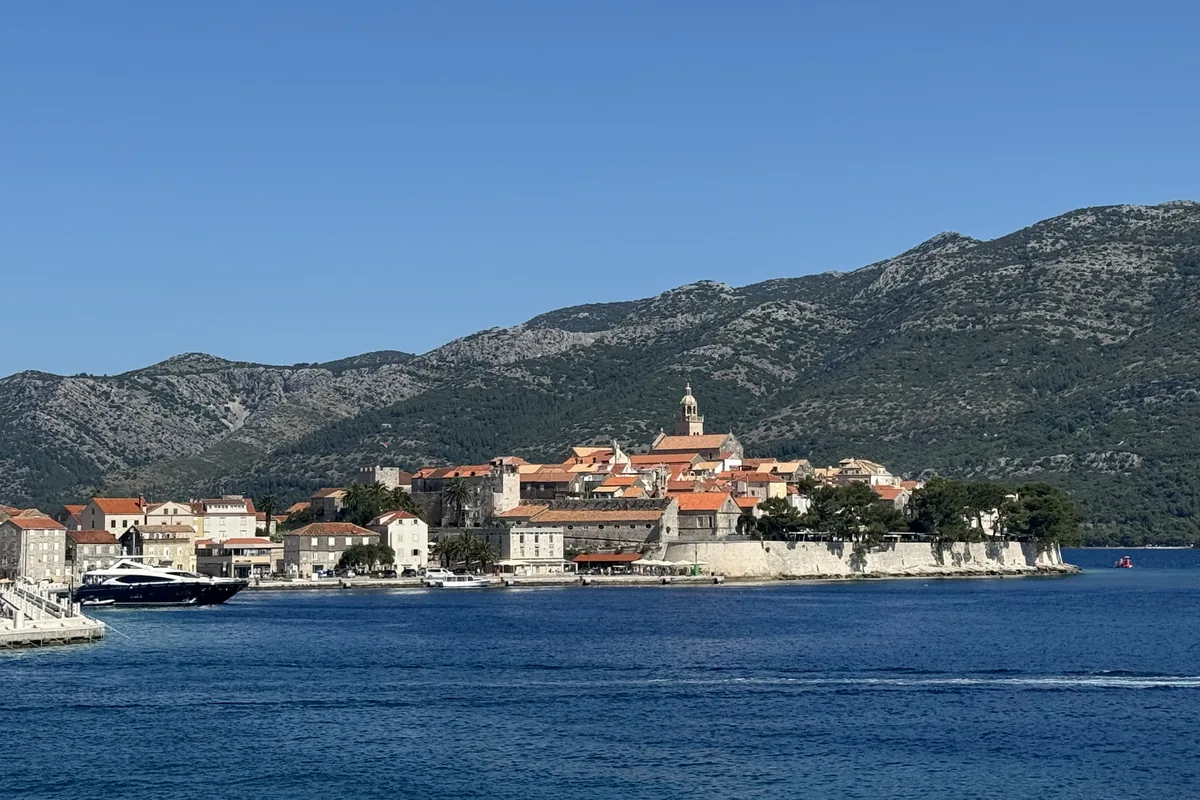
We only stayed one night last time, and we're really glad we did, because we LOVED it — and promised each other that next time in Croatia we'd stay longer. Korčula town, apparently the birthplace and boyhood home of Marco Polo, is a beautiful walled and fortified medieval town rising up a hill on a small peninsula. It's surrounded by water on three sides, with the mountains of a much larger peninsula rising behind it on the mainland side.
The town itself is laid out in an unusual leaf pattern — some say fishbone — with the buildings arranged to block the cold winter winds while funneling cooling summer breezes through the streets. How cool is that? There's a beautiful shaded promenade along one side of the town, full of flowers and the terraces of restaurants, looking out at the sea and the mountains beyond. It is STUNNING.
There are small boutique hotels and VRBOs in and near the historic town, plus a larger resort-style hotel about a ten-minute walk away. (We got great massages there.) That hotel also has fantastic views back across a small bay, with the old town laid out in front of the distant mountains. A lot of folks say Korčula is like a mini-Dubrovnik without all the tourists — which is about right.
Korčula island is quite large — long and narrow. We didn't have time to explore much of it, but there seems to be plenty to do: hiking, biking, LOTS of quiet beaches (and apparently some not-so-quiet beach clubs), interesting local wines famous throughout Croatia and barely sold outside the region, and a centuries-old sword dance tradition with public performances on some evenings.
We're going back to relax and explore.
Next down the road — well, down the ferry line — is Dubrovnik, about two hours away. If you haven't been, just GO. It's amazing.
The historic center is huge and ringed by enormous city walls. Walking the walls is one of the top attractions and well worth it — get there EARLY, before it gets hot and before the crowds arrive. If you watched Game of Thrones, you'll recognize this as King's Landing. (They've really fixed the place up since all that dragon damage in the finale.) As you explore on foot — and the whole historic town is closed to anything but foot traffic — you'll spot the steps from Cersei's walk of shame, the little rocky bay where the ships came and went, the Sept. You'll feel right at home.
The city is FILLED with food, mostly outdoor dining along the sides of shaded medieval streets, of which there seem to be hundreds.
Don't skip Lokrum. It's a little park-like island just offshore, with ferries running back and forth every 15–30 minutes — perfect for a half or full day of hiking, swimming and picnicking. You'll find the partially restored ruins of a monastery (the site of several more Game of Thrones scenes), a Napoleonic fort at the island's high point, and a pretty, relaxing spot near the little harbor for an Aperol spritz and a snack.
The one real downside to Dubrovnik is the tourism — it gets CROWDED. It's a major cruise-ship destination and enormously popular. The shoulder seasons, like late May or early June, are probably optimal. We wouldn't go in July or August: too hot, too many people.
There are boutique hotels inside the historic city — that's where we stayed, and we liked being able to step straight out into the town and all of its restaurants and history. Modern Dubrovnik, outside the walls, is quite big, with some large resorts on the coastal outskirts that look beautiful from a boat. Day-tripping into the old city from one of those is easily arranged, and may be another fun way to do it.
One practical note: Dubrovnik's airport is much larger than Split's, with a lot more connections — worth keeping in mind when you plan your flight home.
We really liked the Croatians we met. For one thing, EVERYBODY speaks English — like REALLY GOOD English. Like better than Tim's English. After the break-up of Yugoslavia in the early '90s, Croatia decided to turn west: Russian was largely dropped as a foreign language and English instruction became a requirement in schools. One fellow told us it starts in first grade and most people get twelve years of it. And nobody is the least bit snooty about it. (Compare that to Italy or France, where you can get a lot of eye rolls if the waiter has to lower himself to speak English.) Folks there seem well read and remarkably up on American television, too. You will have no difficulty communicating with anyone in Croatia.
The food is REALLY good. Croatia sits just across the Adriatic from Italy, and much of the food culture is very similar. Tim had his best pizza EVAR at a little restaurant on the island of Vis, not far from the nudist beach — it was AMAZING, and Tim has been to Naples twice. There are also a number of excellent Croatian seafood dishes and seafood stews (surprise).
You HAVE to order peka. Meats, seafood and vegetables cooked for hours under a big metal bell buried in hot coals. It's a genuinely special meal — but you need to order it well in advance, usually the day before.
The wines are great. The Dalmatian coast has been a hotbed of viticulture for millennia and they have it thoroughly figured out. The Pošip — a golden-colored white that comes from Korčula — is in particular fantastic.
And the gelato is everywhere, and it's amazing.
So definitely spend as much time as you can in Croatia before or after the charter. You won't be disappointed.
Full charter details on the Upcoming Charters page, and the cost picture on What It Costs.
A $300 deposit holds your cabin. Thinking about adding land days in Split, Korčula or Dubrovnik? Ask us — we're planning ours too, and we'll happily compare notes.