
Every question we've ever heard from a new guest. Answered honestly.
When Tim and Donna first stepped aboard a catamaran — before any of this, before the captain's license and the logbooks and the absurdly long anchor chain — they had questions. A lot of them. And they didn't entirely know who to ask.
So consider this page our version of the answer we wish we'd had. We'll be direct and always honest. If a week at sea is something you're considering but something is holding you back, this is the page for you.
Our complete pre-departure safety briefing — fire, dinghy operations, man overboard procedures, swimming rules, and yes, the Poo Talk. Required reading before we cast off. The Serenity image at the end is worth the price of admission.
Absolutely not. Zero. None. We don't expect you to know a halyard from a happy hour (though by the end of the week you'll know both). You are guests, not crew — unless you want to be involved, in which case we'll happily teach you as much or as little as you like. Many guests who arrive knowing nothing leave knowing how to helm, trim a sail, and catch a mooring ball. It's entirely up to you.
This is far and away the most common concern we hear — and we take it seriously. As a physician, Tim has a very clear-eyed view of what works and what doesn't. Catamarans are dramatically more stable than monohulls, our routes involve mostly protected waters, and we have an arsenal of prevention and treatment recommendations. We've dedicated an entire section to this below — but the short version is: it's manageable, and we'll make sure you're set up for success before we ever leave the dock.
Smaller than your house. More comfortable than you'd think. The catamarans we sail are generally 42–45 feet — which sounds tiny until you realize it means everyone has their own private cabin with an ensuite head (that's boat-speak for bathroom) and that there are multiple distinct "hang-out areas" where you can be social or find privacy depending on your mood. We typically dine together al fresco in the cockpit, swim off the back of the boat before breakfast, and fall asleep to the sound of water. By day three, most guests say it starts to feel remarkably natural. By day six, most guests don't want to go home.
Yes — and we mean that in the best possible way. This isn't a cruise. Tim and Donna are your hosts, not your staff. When the dinghy needs hauling, we haul it together. When something needs cooking, we cook together. When a line needs handling, whoever's closest handles it.
Most guests are surprised by how naturally this happens — and how much they end up loving it. There's something genuinely satisfying about being useful on a boat. By day three, you'll be eyeing the helm. We'll let you.
Typically one to three other couples total, including Tim and Donna as your hosts. We keep things intentionally small — this is not a party boat, it's not a flotilla, and it doesn't feel like a cruise. It feels more like a week away with close friends in a remarkable place.
We cut you adrift. NO!! Genuinely honest answer: in our experience, the people who worry most are often the ones who end up loving it most. But if you're truly uncertain, consider this — we're usually in beautiful places with excellent snorkeling, fresh food, warm water, and spectacular sunsets. Even on the rare day when the passage is bumpy or a passing squall has us confined to quarters for a few hours, the destination tends to make up for it. We've never had someone leave wishing they'd stayed home. That said, if you're deeply uncertain, let's talk before you book. We'd rather have the right conversation upfront.
There is no typical day — and that's somewhat the point. But roughly: coffee and breakfast before the sun gets serious, some sailing mid-morning (usually 2–4 hours, sometimes less), an anchorage by early afternoon, swimming and snorkeling, sundowners in the cockpit, dinner aboard or ashore. We plan each next day together as a group over drinks after dinner. Repeat, with variations, for seven of the best days you'll remember for years.
We eat extraordinarily well. Breakfasts, lunches, and dinners are planned in advance with your preferences in mind. We usually dine ashore most evenings, since there are amazing restaurants almost everywhere we stop. If you and the group like to cook, we've got all the kitchen appliances and gear, plus a BBQ aft. Nobody has ever gone hungry. Nobody has ever complained about the snacks. The open bar is always open.
It varies by destination. In the BVIs we have on-board WiFi (via cellular network) with generally very good service throughout most of the archipelago — we can stream movies at most anchorages. In the Med, you'll have cell service in most places. French Polynesia: less so. Most guests report that being mostly offline is better than they expected. You'll have plenty to do.
It's the question nearly every new guest has — and the one they're often too polite to ask directly. Am I going to be miserable? It's a fair concern. Maybe you've been seasick on a ferry, a fishing boat, or a cruise ship.
Good news: a catamaran is an entirely different animal. And as both a physician and your captain, Tim is in an unusual position to tell you exactly why — and exactly what we do to make sure everyone has the time of their lives.
"I was absolutely certain I would be sick the whole trip. I'd been seasick before and nearly swore off boats entirely. But on the Irish Wake, I had the best week of my life. The cat barely moved."
— Past Guest, USVI Charter
Seasickness is caused primarily by rolling motion — the side-to-side rocking from waves. Monohull sailboats are designed to roll and recover, which is great engineering but rough on stomachs.
A catamaran doesn't work that way. Two wide hulls create a dramatically more stable platform. The motion tends to be a gentle fore-and-aft pitch rather than side-to-side rolling. Most people who've been sick on other vessels are genuinely surprised by the difference.
The BVIs are very casual. Less is almost always more — soft-sided bags preferred, and if you're bringing two suitcases, if you can nest one inside the other for storage during the week, even better. You won't need much.
If you're bringing two hard-sided suitcases as a couple, try to nest one inside the other for storage during the week, if you can. (Don't worry — although storage is a little tight, we'll find a place for all empty suitcases for the week!)
"I didn't think you were serious about how important the knots are. If I had known, I would have learned them ahead of time! Knowing them makes everything so much easier." — Exact unsolicited testimonial from a previous crewmate
Please be the first crewmember in history to have these knots learned before you get on board. We know you won't. But we have to try.
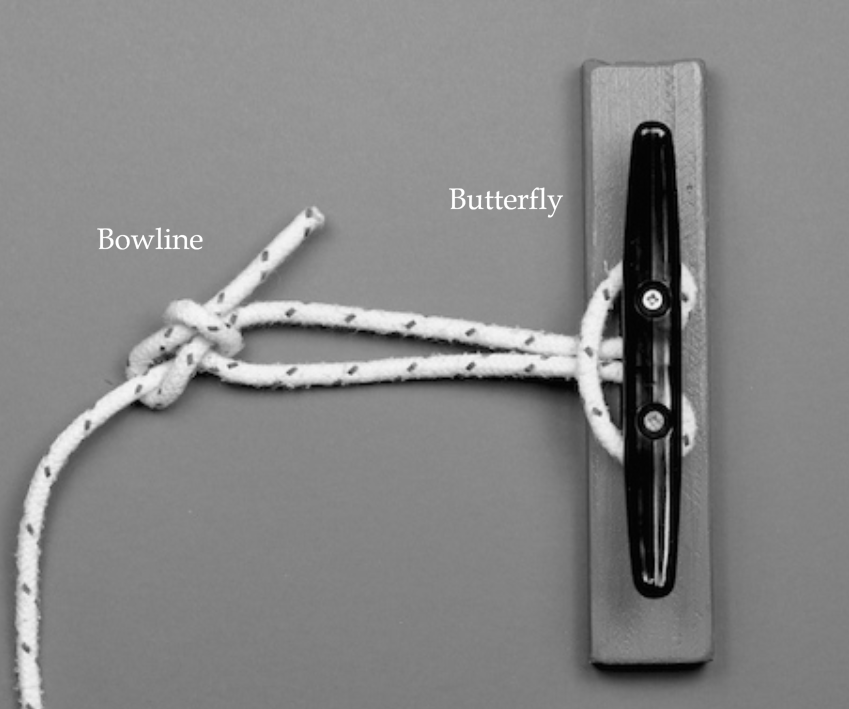
Creates a loop at the end of a line that won't slip or slide. Quick to tie. Easy to untie. We use it several times a day to secure to mooring balls, tie off dinghy lines, and much more. Once you know it, you'll use it back home too. Double bonus points: You can "butterfly it" to a cleat, which we do ALL the time. Once you see this picture, you can't unsee it! Watch the video →
Looks simple and kind of is — but it's the perfect knot for securing and adjusting fenders (the things that prevent us from scratching up the sides of our boat on other boats). We'll be tying fenders to safety lines constantly, especially when coming into a marina. Fast to tie. Easy to untie. Easy to adjust when we're about to slam into someone's superyacht. Watch the video →
We use this to secure lines to cleats — which we'll be doing many times a day, often with some urgency. The last part (that final lock twist) is where almost everybody goes wrong at first. If in doubt, use the cheater OOXXOO method: two wraps around the base, two crosses over the horns, two more wraps around the base. That'll get us temporarily secured while we come back and do it properly. Cleat Hitch Video → OOXXOO Cheater Method →
Used to garrot the person who is trying to teach you about knots. See photographic evidence below of a smartly-placed Dena Dangle — fashioned by Dena herself. If you can successfully garrot your significant other on the first try, congratulations: you're already ahead, and you only have three more knots to learn.

Assuming three couples on the boat (Tim & Donna plus two guest couples) for a one-week BVI charter.
| Expense | Per Boat / Week | Per Couple / Week |
|---|---|---|
| Charter cabin fee | — | $2,000 |
| Provisions (food & open bar) | ~$1,500 | ~$500 |
| Mooring & docking fees (BVI) | ~$55/night | ~$130 |
| Fuel (included most destinations) | Included | Included |
| Boat insurance | ~$875 | ~$290 |
| Local taxes, permits, fees | Variable | ~$50 |
| Ice, trash removal | ~$60 | ~$20 |
| Estimated Total — BVI | ~$2,990 / couple |
This estimate includes: one double cabin, breakfasts, some lunches, open bar throughout, fresh fruit and snacks, one dinner aboard, mooring/docking fees, fuel, insurance, local taxes, and ice/trash removal. Not included: dining out at restaurants, boat toys (kayaks/paddleboards ~$200/week each). In the Mediterranean, we have to purchase a full tank of gas up front, which is ~$1,400 (or ~$470/couple/week). Also mooring and docking fees in the Mediterranean are MARKEDLY higher than in the Caribbean — in the range of €100 to €400 per night.
We want to keep expense tracking as simple as possible. We put a large EXPENSE envelope containing a pad and pen in the navigation station. Whenever you pay for something for the group — dinner, ice, whatever — write yourself a receipt (e.g., "4/18 Tim Ice $10"), note the currency if relevant, and put it in the envelope. After we get home, we add everything up and divide evenly for a final reconciliation. Receipts get a name on them. That's it.
If you're a systematic person and want to track more granularly, we will enthusiastically nominate you as official Quartermaster and hand over the envelope with all the awesome power that comes with it.
Download these before you arrive. Play with them during a boring meeting. They'll get you in the right frame of mind — and some of them will actually be useful on the boat.
There are no dumb questions when you're trying to decide whether to commit to a week at sea. Drop us a note — we're happy to talk through anything.