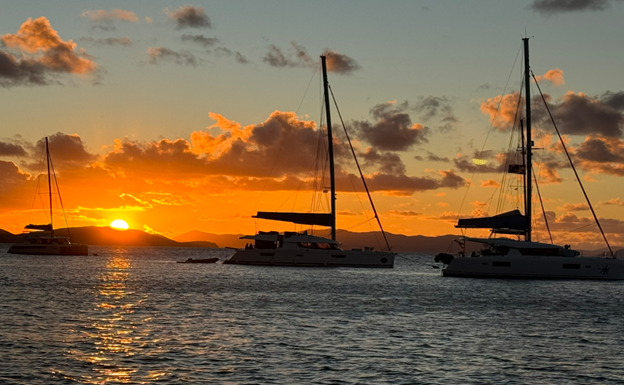
We're glad you're sailing with us!
We hope sharing some of these safety details with you in advance will help prepare you for a fantastic adventure. Our number one goal throughout the trip is to get everybody back to the dock happily and safely!
(Although we mention the Irish Wake and the BVIs specifically in this briefing, the boats we typically charter in other destinations are either identical or nearly identical — so quiz your skipper and try to stump him on any important differences in safety equipment or storage locations.)
📋 In This Briefing
- Save Local Contact Info
- Fire — In General, The Biggest Maritime Threat
- Securing the Ship Before Getting Underway
- Safety Equipment & Location
- Dinghy & Davit
- Dinghy Launch Checklist
- Dinghying onto a Beach
- Moving Around the Irish Wake While Underway
- Swimming
- MOB — Man Overboard
- Emergency Communication
- The Poo Talk
- And Now, the Serenity
1. Save Local Contact Info
Please save your skipper's phone number as well as the local phone numbers for the Moorings and VISAR (Virgin Islands Search and Rescue — or similar Coast Guard-type organization where you are sailing) in your phone before we depart. We want to make sure everyone has these numbers immediately available even when we are not on the Irish Wake. The numbers are on a sheet in the nav station.
2. Fire — In General, The Biggest Maritime Threat
Location of fire extinguishers on the Irish Wake:
- In the hanging locker of all three cabins
- In the galley floor locker near the forward door
- In a cockpit locker
There is also at least one fire blanket (especially useful for stove fires) in the forward galley cabinet. You can also use it to smother other fires or to cloak yourself for protection during a worst-case fire scenario.
Some hatches can be used for emergency exits and they are clearly marked.
Small, square, raised indicators are located throughout the ship to identify the location of fire safety equipment and exits. Please look for these and touch them anytime you walk past so you develop the muscle-memory to find them even in the dark.
For engine fires, be aware:
- We have two automatic fire suppression systems (one for each engine room). Indicators are at the helm.
- These systems can also be manually triggered by controls located in the aft cabins under each berth, if needed. Your skipper will show you the location.
- We also have a fire extinguisher port for each engine room. Please ask the skipper to show you the location before we leave.
If we ever have a fire, we need to turn off the Main Electrical Switch — on the Irish Wake, it is located in the saloon immediately inside the sliding glass doors, behind the baseboards under the dinette bench. Please review its location with the skipper in advance. It's a bit hidden.
3. Securing the Ship Before Getting Underway
Keep ALL drawers closed and latches locked especially before and while underway. The big drawer under the oven is especially dangerous — it's really heavy and could hurt someone's foot if it slides open unexpectedly.
Close and seal all hatches and side windows in the cabins each morning before we get underway. This is really important. You do not want a cold, wet, salty bed or flooded hull!
Flush all the water out of your toilet before we get underway. You do not want toilet water sloshing around in your head or cabin! It's always best to keep the toilets empty so you don't even have to think about it — you can fill the toilet to your desired water level right before you need to use it.
Secure breakable items inside the lowest cabin lockers protected with soft items like clothes. The cabin berths are also generally pretty safe, especially if breakable items are surrounded by pillows.
Your skipper will do a complete exterior walk-around each morning looking for open hatches and unsecured items. You are welcome to join! Please help by checking that your own cabin is secure and ready to go.
4. Safety Equipment & Location
Most of our personal safety equipment on the Irish Wake is located in the locker under the aft dinette bench in the saloon. Please be sure you know where these items are.
Make sure you know how to clip the low-profile, automatically-inflating life vests closed around you. It's trickier than airplane life vests — please have your skipper show you how, and practice.
We also have harnesses, clip-in lines, decklines, and a couple of sets of foul-weather gear, if needed.
There is no requirement to wear life jackets while underway — it's your call — but your skipper usually will if it is wavy or rough at all. Good rule of thumb: watch the Admiral! If she has donned her life jacket, you'll probably want to don yours as well.
5. Dinghy & Davit
Driving the dinghy is SUPER fun (and you are, of course, welcome to do so)! But the dinghy and davit (the crane-like equipment that raises and lowers the dinghy) are, by far, the most routinely dangerous parts of the boat. Please be super cautious using them.
While getting on/off the dinghy, there is a significant risk of falls — for everybody, even for those who are light on their toes. Move super slow and carefully time your movements to the waves. There is no shame in the old butt-based-scooch-onto-the-dinghy-on-your-rear move, if it helps you. WATCH THE WAVES. WATCH THE WAVES.
Also watch the davit lines while boarding — they have heavy steel clips at their ends that can swing into your face or head. A good practice is to grab onto a davit line as you board — it gives you something secure to hold, steadies the dinghy, and prevents the clips from swinging.
Watch out at dinghy docks — there are always lots of splinters, rusty nails, etc.
The dinghy motor starts with a hard pull on a cord — just like a lawnmower. One of the most common serious injuries in sailing occurs when the dinghy skipper pulls the starter cord and his/her elbow smashes into the face of another crew member. (Let's not be that crew!) The dinghy skipper should always start the motor BEFORE others board, with the motor in neutral. If you must start it with others aboard, pull the cord so your elbow always travels downward — and alert your dinghy-mates first. Sailing etiquette suggests it's always nicer to smash someone's thigh than their face.
6. Dinghy Launch Checklist
- ☐ Dinghy boat plug is plugged in before lowering the dinghy. (Who among us hasn't accidentally flooded a dinghy or two…or three?)
- ☐ Dinghy painter line is securely cleated to the Irish Wake before releasing from the davit. (Who among us hasn't had an unsecured dinghy float happily away?)
- ☐ Painter line is far, far away from the dinghy prop. (They attract each other with animal magnetism. Who among us hasn't had the great joy of untangling a painter wrapped around a prop?)
-
☐
Dry-bag in the dinghy with the following items, fully charged and working:
- Portable VHF radio
- At least one cell phone
- 2 flashlights
-
☐
Also confirm these items are in the dinghy:
- A couple of life jackets
- At least one gallon of water
- Sunscreen
- The rope ladder
- ☐ DO NOT cast off the dinghy line until the motor is running! (This happens every charter. Who among us hasn't floated away in a dinghy that won't start?)
- ☐ Dinghy skipper has the kill-switch cord around his/her wrist. (It kills the engine if you fall overboard.) Remind your skipper — he always forgets.
7. Dinghying onto a Beach
Most of the time, we'll be driving the dinghy to a dinghy dock (which makes boarding and disembarking pretty easy). But sometimes we will take the dinghy up onto a beach, which can be a bit trickier, especially if it is wavy.
The dinghy skipper will usually give a burst of speed right before we land, then quickly kill the engine and pull the motor up (so the prop doesn't get stuck in the sand). This all has to happen very quickly, right as we are crossing breaking waves with no more steering or power. The number one goal for the crew during this final phase of landing is to keep the dinghy perpendicular to the waves. This means that right as the dinghy stops moving forward, someone (usually one or two people) at the bow will have to jump in on either side and walk the dinghy forward keeping it perpendicular to the waves. (It will typically be knee deep or less — but it could be waist deep or more.) Remaining passengers can then jump out once the boat is up on the beach.
The minute the dinghy is given a chance, it will immediately try to go broad to the waves (i.e. parallel to the waves) — which can be a bit dangerous since a broadside wave can, in principle, flip the dinghy over (engine and all), possibly injuring anyone remaining on board. So keep your wits about you. Confident swimmers and sailors should take the lead at the bow to prevent the dinghy from going broadside. It is easily done.
If the boat does go broad to the waves and the waves are threatening, the remaining crew should exit the dinghy on the seaward side as a precaution. You'll get wet, but you'll be able to touch the bottom and walk in safely — and the dinghy won't tumble onto you.
7. Moving Around the Irish Wake While Underway
You are absolutely welcome to move around the yacht while underway — but please use lots of caution. We don't want anyone falling, or especially falling in.
- Keep at least one hand on the boat at all times (preferably two). Think of yourself as Tarzan swinging from handhold to handhold.
- Move through the saloon (center of the ship) whenever possible while underway.
- Avoid the outer walkways on the sides of the boat whenever possible while underway.
- Use the buddy system — always have your buddy clearly identified (say "Hi Buddy" to the person next to you) and track where your buddy is at all times. Make sure your buddy returns when expected after heading inside or to the head — or has at least found a better buddy somewhere else.
8. Swimming
Despite generally calm weather, warm seas, minimal tides, weak currents, and protected beaches, the BVIs are said to have one of the highest per capita drowning rates in the world! And I've heard that 100% of drowning fatalities involve tourists. (Obviously the kind of thing a local would say — but let's pretend it's true for a minute.)
We want to enjoy the water A LOT — but we need to exercise caution.
- SWIM LADDER DOWN FIRST. Always put down the swim ladder before jumping in! Your skipper will try to remember to drop it as soon as we moor or anchor. If you see it up, feel free to drop it yourself.
- IF THE SWIM LADDER IS UP and you're in the water: (1) Call for help. (2) Climb aboard the dinghy — it's much easier, and there's usually a rope ladder reachable from the water.
- THROW OUT A FLOATING LINE. We ALWAYS attach a nylon floating line to the boat and throw it out behind before anyone gets in the water. Then we throw in the best swimmer to test the current. Stay near that line and that swimmer until you get a feel for things — currents can be much stronger than they look. (Saba Rock is a good example. The long tail-end of the dinghy painter line is great for this.)
- WEAR A YOKE. Not required, but a really good idea. It dramatically increases your visibility to other boaters, and you can always put a few puffs of air in for extra buoyancy. We have plenty on board.
- WEAR FINS if you are a good swimmer and comfortable with them. They'll help you zip through the current and make treading water effortless. Plus we'll nominate you to swim the mooring line. Lucky you!
- JUMP IN FROM THE STARBOARD SUGAR SCOOP. The sugar scoops are the platforms at the very aft end of each hull. The port-side sugar scoop has the swim ladder — you don't want to land on it or on swimmers nearby. Starboard is the way to go.
- AVOID HANGING OUT NEAR THE SWIM LADDER. It semi-floats and bangs around with the waves, and has pinch-points that can injure your fingers and hands. When you use it, climb up quickly and move away. Hold the rungs — not the metal sides where the folding pinch points are. WATCH THE WAVES. WATCH THE WAVES.
- Midnight skinny dippers (not officially endorsed by the on-ship compliance officer) — go in with your buddy for all the obvious reasons, with a line out and the swim ladder down.
9. MOB — Man Overboard
(I know this is extremely suboptimal terminology, but "MOB" is what you will see on the chart plotter and it's used by the Coast Guard and other vessels — so for clarity and consistency, let's keep it.)
MOB means someone falling in the water while the vessel is underway. (Falling in while moored? That's just on you.) Boats don't have brakes — stopping a boat under sail is even trickier — and MOBs can disappear from sight very quickly. We, the crew, are the MOB's best hope for survival by a long shot. Search and rescue teams are always many minutes away, at best.
Your skipper will show you the MOB button on the chart plotter. Push it the moment you recognize an MOB event — it records the boat's exact position at that instant. We also have several throwable flotation devices on board; your skipper will walk you through them. Job one: get flotation to the MOB.
General MOB Procedure
- The first person to see it YELLS "Man Overboard!" loudly and repeatedly until everyone's attention is captured. The helmsman pushes the MOB button on the chart plotter and all crew muster in the cockpit immediately.
- Crew throws flotation to the victim. Then all crew don life jackets — the only thing worse than one MOB is two MOBs.
- The skipper designates a spotter — usually the person who first saw the event. The spotter keeps CONSTANT eyes on the MOB and points with a raised arm that the skipper can see. A MOB's head may only be visible for an instant on the crest of a wave every 30–40 seconds. The skipper is focused on navigation; the spotter is critical.
MOB Retrieval
- Skipper starts engines, drops the mainsail, releases the genoa, and comes about. If crew are available and comfortable, help by furling the genoa, guiding the mainsail down, and locking in the boom with the main sheets. In some conditions, we might alternatively sail back to the MOB and perform a sailing stop maneuver called a "heave-to." Follow the skipper's instructions.
- Crew prepares a nylon (floating) line and horseshoe.
- Crew unties the dinghy painter from the davit posts — ready for a possible dinghy launch if needed. Don't lower the dinghy unless the skipper requests it. Just hold the painter to prevent excessive dinghy swinging.
- We bring the Irish Wake alongside the MOB at about midships, just downwind, and stop engines there. Crew meets the MOB at midships, lowers a line (attached to a horseshoe float or life vest if possible), communicates the MOB's position to the skipper constantly, and guides the MOB aft toward the swim ladder. Lower the ladder and pull the MOB to safety.
10. Emergency Communication
VHF Channel 16 — "Mayday" — imminent threat to life or loss of vessel (including an invisible MOB).
VHF Channel 16 — "Pan-Pan" — serious distress, but not yet life-threatening.
All crew should know these terms and the following basics — because if your skipper falls in, he has little confidence in your ability to turn the boat around and come get him!
- Know how to turn on both the ship VHF and the portable VHF
- Know how to change to Channel 16 (the universal maritime distress and hailing channel)
- Know how to turn up the volume
- Know how to toggle from low-power to high-power (often labelled "5 watts" or "25 miles") — use high-power for all emergency broadcasts
- Know where the broadcast (Talk) button is located, and remember to release it when not speaking
There are 2 VHF stations on board. We also bring a hand-held portable VHF on all dinghy excursions.
11. The Poo Talk
Please review the operation of the marine heads with your skipper! Positive note: The heads on the Irish Wake are all electric and all use fresh water — much nicer than the old manual pump, saltwater alternative. This ain't your grandpappy's old leaky scow. We're talking extraordinary luxury here!
The Poo Talk will cover:
- How to fill the commode with water
- How the macerator works, and how to be really nice to your macerator — he needs something nice in his life!
- Toilet paper and how much to use with each flush (hint: it's WAY less than you're going to try to get away with)
- Flushing technique
- How to know if your sewage tank needs to be emptied
Remember, we don't have an on-board plumber. When in doubt: less toilet paper, more water, more flushing. It's much better to flush multiple times than to tackle one enormous project in a single go.
Extra credit: learn how to empty your own tank! (This is not exactly your skipper's favorite job.) We'll always empty tanks far out at sea in areas where dumping is legal.
We're All About to Have a GREAT Time!
Let's all keep an eye on each other, gently remind one another when something safety-related needs reminding (especially if you see your dead-beat skipper doing something stupid or forgetting something critical) — and expect that we'll have a few problems and challenges here or there that we'll have fun figuring out together.
And now, the Serenity.